Why you can’t just own your Delaware C-Corp with an Indian subsidiary (and the LLP route that fixes it)
The most common structure in Indian startups — Delaware parent, Indian subsidiary — is one an Indian resident isn’t allowed to own directly. Here’s the plain reason, and the fix almost everyone uses.
The short answer
An Indian resident can invest in a US company under FEMA — but not in one that has an Indian subsidiary the resident controls. Since most startups need exactly that shape, founders hold their US shares through an Indian LLP instead — one LLP per founder — which is allowed to do what an individual can’t.
Here’s a strange fact about Indian startups. The most common structure of all — a US company on top, an Indian company underneath — is one you’re not allowed to own directly. Not “shouldn’t.” Not allowed.
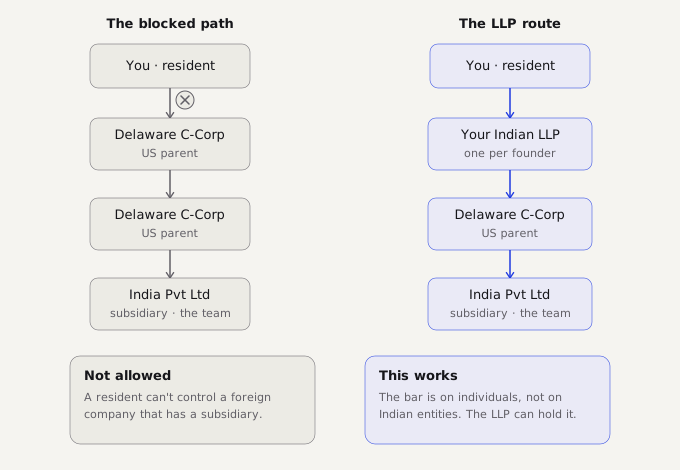
I’ve walked more than a hundred founders through this, and the reaction never changes: wait, that can’t be right. It is. And once you see why, the odd little workaround — a small Indian partnership sitting between you and your own company — stops looking odd and starts looking obvious.
Let’s build it from the ground up.
First: are you a “FEMA resident”?
Everything here turns on one label. Under India’s foreign-exchange law, are you a resident or not? It’s not the same as income-tax residency — it’s a separate test with its own rules.
The rough version: if you’ve been living in India, you’re a FEMA resident. A little more precisely — you’re a resident if you spent more than 182 days in India last financial year, unless you’ve left for a job, a business, or an open-ended stay abroad, in which case you flip to non-resident the day you leave.
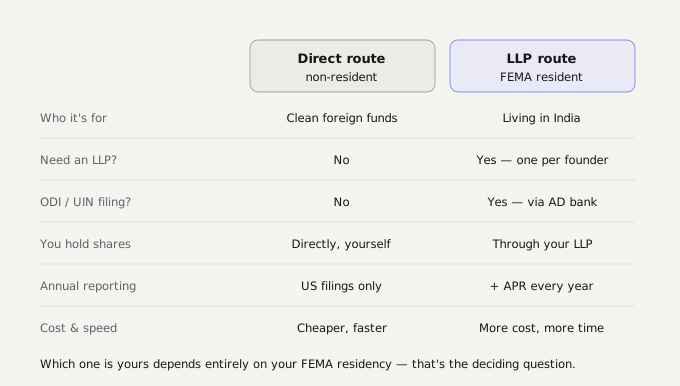
If you’re reading this from Bengaluru and haven’t recently moved abroad, you’re a FEMA resident. That’s the case the rest of this article is written for. (Not sure? The residency guide walks through it properly — it changes your whole route.)
The actual rule — §2(v), FEMA 1999
Section 2(v), Foreign Exchange Management Act, 1999 defines a “person resident in India” as, among other things, a person residing in India for more than one hundred and eighty-two days during the preceding financial year — excluding a person who has gone or stays outside India for employment, for carrying on business or vocation, or for any purpose indicating an intention to stay outside India for an uncertain period; with the mirror carve-in for those coming to India for those purposes. Section 2(w): a “person resident outside India” is a person who is not resident in India. Physical presence sets the default; purpose and intention override it.
Source: FEMA, 1999 (RBI).
In short — if you live in India, assume you’re a FEMA resident — and that this article is about you.
What does FEMA let a resident do with a foreign company?
More than you’d fear, less than you’d like.
You’re allowed to invest in foreign companies. There’s an annual limit — currently USD 250,000 per person — and inside it, buying shares of a US startup, even founding one, is fine.
But one condition changes everything for founders. As a resident, you can hold a foreign company that has a subsidiary under it — only if you don’t control that foreign company. And control is a low bar: 10% of the votes, or a seat that steers the company, clears it. A founder clears it easily. That’s rather the point of being a founder.
There’s a second catch for one group. If the company you’re building is itself in financial services — lending, payments, broking — the direct route is closed to you even with no subsidiary at all. Fintech founders hit an extra wall.
The actual rule — Schedule III, OI Rules 2022
Paragraph 1(2)(i), Schedule III to the Foreign Exchange Management (Overseas Investment) Rules, 2022 permits a resident individual to make or hold ODI in “an operating foreign entity not engaged in financial services activity and which does not have subsidiary or step down subsidiary where the resident individual has control in the foreign entity” — subject to the LRS ceiling. “Control” includes the right to appoint a majority of directors or to control management/policy decisions, including via 10%+ of voting rights. So a resident may hold a foreign entity with subsidiaries provided they lack control — and a controlling founder of a Delaware company that owns an Indian subsidiary is exactly what this paragraph disallows.
Source: OI Rules, 2022 (eGazette).
In short — you can own a controlled foreign company, or one with an Indian subsidiary — just not both at once.
So why does every startup end up needing that Indian subsidiary?
Because your team is in India. That’s the whole answer.
You incorporate in Delaware because that’s where the investors are, and you build in India because that’s where the engineers are. But a Delaware company can’t run Indian payroll — no Indian presence, no PF, no ESI, no way to employ people here properly.
Founders paper over this with contractors, and for a few months it holds. Then three problems arrive.
The people problem: contractors don’t get offer letters, PF, gratuity, or clean stock options. Good hires eventually want real jobs.
The tax problem: a team in India working for a US company with nothing in between can create a taxable presence for that US company in India — and then India taxes a slice of its profits. The fix isn’t to hide the team. It’s the subsidiary: an Indian company that employs everyone and bills the US parent a fair price is the standard, accepted way to keep this clean. The subsidiary is the solution, not the risk.
The IP problem: code written by loosely-papered contractors is a mess waiting for your first serious investor’s lawyers.
The clean fix for all three is the same — the Delaware parent opens a wholly-owned Indian subsidiary that employs the team. Which is how you land on the classic shape: US parent, India subsidiary.
In short — your team is in India, so you need an Indian company to employ them properly — which means a subsidiary.
See the trap?
Walk the loop. You’re a FEMA resident. You control your Delaware company. It needs an Indian subsidiary. And a resident can’t hold a controlled foreign company that has a subsidiary.
The exact structure every US investor expects is the one you’re not allowed to hold directly. It’s not an oversight — the rules deliberately watch for money looping back into India — but it’s a wall, and you need a way through it.
The way through: hold it through an LLP
The restriction is on you as an individual. So you stop being the individual who owns the shares.
An Indian business entity — including an LLP — plays by a different rulebook, and that rulebook lets an Indian entity own a foreign company that has subsidiaries. So instead of you holding the Delaware shares, your LLP holds them. That one swap moves you out of the blocked category.
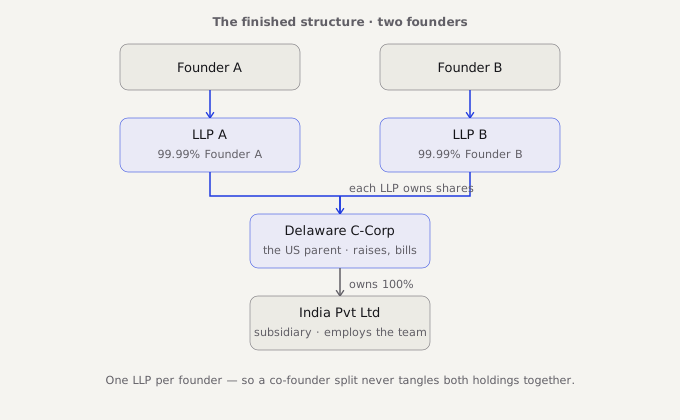
Picture two founders, A and B. Each sets up their own LLP. An LLP needs at least two partners, so each founder takes 99.99% and gives a sliver to someone they trust completely — usually a parent or spouse. Founder A’s LLP buys Founder A’s shares; Founder B’s LLP buys Founder B’s.
One detail that matters more than it looks: that sliver partner must be an Indian resident. Put a non-resident in that seat and the LLP itself starts to look like foreign money, which quietly undoes the whole point.
Why one LLP each, not one shared LLP? Because a shared LLP welds your holdings together. If the founders fall out — and it happens — splitting one LLP becomes a second fight on top of the first. Separate LLPs keep each founder’s shares, exit money, and taxes cleanly their own.
Careful — what this route actually is.
The honest part most people won’t say: there’s no rule that states “a holding LLP is fine.” What the rules say is that an Indian entity may invest abroad for genuine business — and an LLP built only to hold one company’s shares is exactly where that gets tested. The route is widely used and broadly considered sound, because the individual bar doesn’t apply to entities. But it’s market practice backed by legal reasoning, not a written safe harbour. Set it up with a FEMA-aware lawyer, not off a blog post — including this one.
In short — the individual can’t hold it, but the individual’s LLP can. One LLP per founder, set up with counsel.
How does the money actually get there?
Here’s where three new terms show up. Take them one at a time — each is simpler than it sounds.
You can’t just wire money to your US company. India requires a specially authorised bank to handle any investment going abroad, and to report it to the RBI. These authorised banks are called AD Banks, and you pick one to run your transaction.
The investment itself — your LLP buying shares in a foreign company — has a name too: Overseas Direct Investment, or ODI. It’s just the official term for “money going out to buy a foreign company.”
And before any money moves, the RBI issues a file number for your Delaware company — a Unique Identification Number, the UIN. Every future transaction with that company gets reported against it. Think of it as your company’s permanent reference number with the RBI.
One distinction founders routinely miss: incorporating the US company and owning it are two separate events. Whoever files the incorporation — a platform, an agent, anyone — is only the “incorporator”; that role brings the company into existence but confers no ownership. You become an owner one way: the company issues shares and someone pays for them. In this structure, that someone is your LLP — it subscribes to the C-Corp’s stock, and the money that travels from your LLP’s Indian bank account to the US company’s bank account to buy those shares is the actual overseas investment. That share-purchase remittance — not the incorporation — is the event ODI reporting exists to capture. No subscription, no ownership; and that one cross-border payment for shares is the whole thing FEMA is watching.
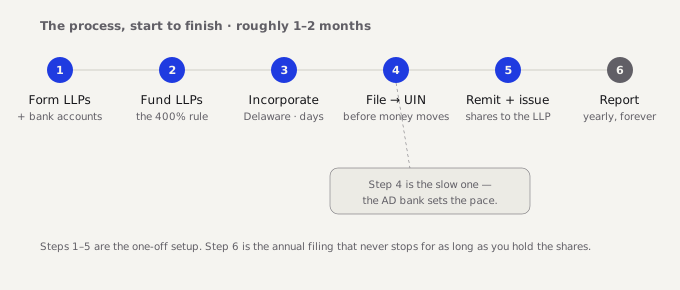
Put together, the sequence looks like this:
Set up each founder’s LLP and open its bank account.
Put real money into the LLP. An Indian entity can invest abroad only up to four times its own net worth — and a brand-new LLP’s net worth is basically zero. So the partners fund the LLP first. Decide how much the US company needs, then work backwards. (How much, exactly? That’s the capitalising guide.)
Incorporate the Delaware company. Platforms like Stripe Atlas or Clerky make this a form-filling exercise — but they only handle the US side, never your India paperwork.
File with your AD Bank, which gets the UIN from the RBI. Only after the UIN exists can the money move.
The LLP wires the money; the US company issues the shares to the LLP; the certificates come back as proof.
Report, every year. Each founder files an annual report on the foreign company by 31 December, for as long as they hold the shares. Miss it and the bank freezes further transactions until you fix it.
How long, and how much? That’s a full guide of its own — the cost and timelines. The short version: one to two months, start to finish.
The actual rule — the ODI machinery
FEM (Overseas Investment) Regulations, 2022: Reg 9(2) — obtain a UIN through the designated AD bank before the outward remittance or the acquisition of equity, whichever is earlier. Reg 9(3) — all transactions for a UIN route through that designated AD bank; multiple resident investors in the same foreign entity use the same AD bank. Reg 10(4) — file the Annual Performance Report by 31 December each year (exempt only if holding under 10% without control and with no other financial commitment). Reg 9(4) — dues from the foreign entity (sale proceeds, liquidation) must be repatriated to India within 90 days of falling due. AD-bank directions: remittance only against a completed Form FC with Form A2. The overseas financial commitment ceiling is 400% of net worth; the round-trip layering limit (Rule 19(3), OI Rules) caps the structure at two layers of subsidiaries.
Sources: OI Regulations, 2022 · OI Directions, 2022 (RBI).
One thing from experience, not the rulebook: banks like the order above — LLP first, then the US company, then the filing — and many want the investment to be the first real money into the new US account. That’s not law; it’s how banks behave, and arguing with your bank’s checklist is a losing game.
In short — a special bank (AD Bank) files with the RBI, which issues a reference number (UIN) before any money moves. Then you report once a year, forever.
What about the US side — and the exit?
The Delaware half is genuinely the easy part: you file the incorporation, appoint a board, sign the founder and IP paperwork, get a tax ID, open a bank account. Platforms automate most of it.
Two things to keep on your radar, though.
Your shares now live inside an Indian LLP — so when you eventually sell, the money lands in the LLP in India first, and there’s a rule that it must come back to India within 90 days of being due. Your exit has an Indian pit-stop built in.
And there’s a US tax election founders usually make within 30 days of buying their stock (the ‘83(b) election’). Whether it even applies when an LLP holds the shares is genuinely unsettled — ask a US tax attorney inside that 30-day window, because it can’t be fixed later.
In short — the US setup is the easy half. Just remember your exit routes through India, and get the 83(b) question answered fast.
So what should you actually do?
If you’re a FEMA resident heading for US investors, the path is set: one LLP per founder, funded properly, investing through an AD Bank with a UIN, reporting every December — all set up with a cross-border CA and a FEMA-aware lawyer. Before you click “incorporate” on any platform, get the India side ready first. Doing it in the right order is a few weeks of paperwork. Doing it backwards — shares already in the wrong hands — is a different kind of problem.
Staring at this and unsure which box you’re in — resident or not, LLP or direct, subsidiary now or later? That’s exactly what a free call is for.
Related guides
Delaware C-Corp for Indian founders · US parent or Indian parent? · Cost & timelines · Incorporation platforms · Capitalising your C-Corp · FEMA residency
Questions people ask
Can an Indian resident own a US company?
Why do Indian founders use an LLP to hold their C-Corp?
Is the LLP route actually legal?
What is a UIN?
Do co-founders need separate LLPs?
How much money must go into the LLP?
What annual filing does the LLP route require?
Can Stripe Atlas or Clerky handle the FEMA side?
Related guides
The IP-before-incorporation question -- coming soon
Returning NRIs / dismantling the LLP later -- coming soon
LRS route for non-controlling investment -- coming soon