How to capitalise your US C-Corp (and the par-value tax trap)
Two numbers you pick casually at incorporation — authorised shares and par value — follow you every year as a tax bill. Pick them on purpose.
The short answer
Work backwards: decide what the company needs for 12–18 months, capitalise each founder’s LLP at a quarter of its share plus buffer (the 400%-of-net-worth rule), and subscribe through the ODI process. At incorporation, the startup convention — 10 million authorised shares at $0.0001 par — also keeps your Delaware franchise tax near the minimum.
Capitalisation sounds like a finance-department word, but for a founder it’s three practical questions: how much money goes in, how it legally gets there, and what the numbers you pick at incorporation quietly commit you to. The third is where the trap lives, so let’s earn our way to it.
How much money should actually go in?
Enough to run the company until its next funding event — typically 12–18 months of the US entity’s own costs (Delaware fees, software, US spend) plus what it sends the Indian subsidiary for the team, via arm’s-length invoicing. There’s no magic number; there is a magic direction: decide the company’s need first, then size everything upstream from it. Undercapitalise and you’ll be doing a second ODI round-trip within months — each remittance is paperwork, so fewer, larger, planned remittances beat a drip.
In short — size 12–18 months of need first, then work backwards. Plan fewer, larger remittances — each ODI trip is its own paperwork.
Why the LLP’s 400% rule sets your floor
Because of how the money legally travels. Each founder’s LLP subscribes to the C-Corp’s shares, and an Indian entity’s total overseas commitment is capped at 400% of its net worth. A fresh LLP’s net worth is zero, and 400% of zero is zero — so the real sequence is: pick the C-Corp’s number, divide by founders, then capitalise each LLP with at least a quarter of its share, plus running costs. The subscription size and the LLP capital are one decision wearing two entities.
In short — a new LLP can invest 400% of a net worth of zero — which is zero. So you fund the LLP first, sized to what the C-Corp needs.
“Authorised shares” and “par value,” and the weird numbers
At incorporation you’ll authorise a pool of shares — the convention is 10,000,000 — and assign them a par value, conventionally $0.0001. Authorised is the ceiling you may issue; issued is what people actually hold. Par value is a legal floor price per share, set microscopic so founders can buy their stock for a few hundred dollars while the company can later sell the same class to investors for real money.
Ten million shares isn’t vanity; it’s arithmetic hygiene — whole-number option grants, clean percentages, room for pools and rounds without amending the charter. And the microscopic par value is what makes founder stock affordable: 4,000,000 shares × $0.0001 = $400. In the LLP route, that tiny subscription cheque is the ODI remittance that makes your LLP the stockholder — which is why even this token amount moves through the UIN-first machinery, not a casual wire.
In short — 10 million shares at $0.0001 par = clean maths and cheap founder stock. The conventions exist for good reasons — take them.
The trap: how par value decides your Delaware franchise tax
Here’s the bill nobody mentions at the pricing page. Delaware charges every corporation an annual franchise tax — a fee for simply existing — and lets you calculate it two ways. You pay the lower, but you have to know to ask.
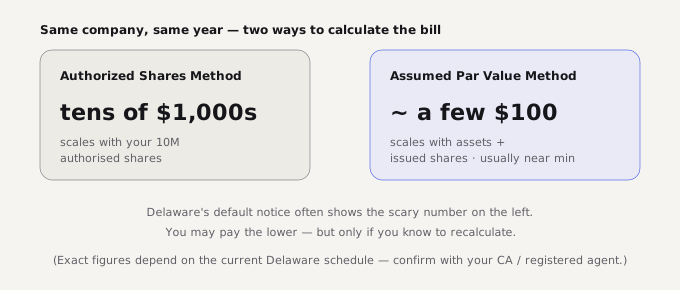
The Authorized Shares Method taxes you on how many shares you authorised — and for 10 million shares it produces a five-figure bill, every year. The Assumed Par Value Capital Method instead looks at your gross assets and issued shares — and for a typical early-stage startup, it lands near the minimum of a few hundred dollars. Same company, same year: one method says tens of thousands, the other a few hundred. Delaware’s default notice often shows the scarier number; the method is your election. Set a high par value or authorise an enormous pool “to be safe,” and you’ve quietly signed up for a bigger annual bill.
The actual rule — Delaware franchise tax, two methods
Delaware franchise tax, Title 8: two computation methods — the Authorized Shares Method (scales with authorised share count; a low-hundreds minimum, rising steeply) and the Assumed Par Value Capital Method (scales with gross assets and issued shares relative to par; its own low-hundreds minimum; both share a cap in the low hundreds of thousands). Corporations also file a short annual report with a small fee, due 1 March.
CA / registered agent: verify the current figures before relying — exact minimums, slabs, cap, report fee, penalties. Figures are described, not printed, until verified. Source: Delaware Division of Corporations — franchise tax calculator.
Careful — franchise tax is owed even at zero revenue.
It’s a Delaware fee for existing — separate from US income tax, your Indian taxes, and everything FEMA. Founders miss the 1 March filing because no one told them it existed; put it in the calendar the day you incorporate. Figures here are described qualitatively on purpose — confirm the current schedule with your registered agent or CA before budgeting.
The short version
Size the company’s 12–18-month need first; capitalise each LLP at a quarter of its share plus buffer; move money in planned, few, ODI-clean remittances. At incorporation, take the boring convention — 10 million authorised at $0.0001 par — and every March, calculate your Delaware franchise tax both ways and elect the lower. The scary number in the state’s letter is usually the wrong method.
Working out your number — and how to get it across the border cleanly — is a fifteen-minute conversation. Book a free call.
Related guides
The LLP route (400% + ODI) · Cost & timelines · Incorporation platforms · Why investors prefer Delaware C-Corps (QSBS) · Delaware C-Corp for Indian founders
Questions people ask
How much should I capitalise my Delaware C-Corp with?
Why do startups authorise 10 million shares at $0.0001 par value?
Why is my Delaware franchise tax bill so high?
Is Delaware franchise tax the same as income tax?
Related guides
The IP-before-incorporation question -- coming soon
Returning NRIs / dismantling the LLP later -- coming soon
LRS route for non-controlling investment -- coming soon