FEMA residency, and why it decides your whole route
Before the LLP route, before ODI, before any of it — one question decides your entire path. Most founders never stop to check it.
The short answer
Your FEMA residency decides your route. A FEMA resident must hold a US company through the overseas-investment process — in practice, the LLP route. A FEMA non-resident, using genuinely foreign-earned money never mixed with Indian funds, can often incorporate directly — no LLP, no ODI. So the first question isn’t which entity. It’s which one are you.
Almost every guide to setting up a US company from India starts the same way: form the LLPs, file the ODI, get the UIN. All of it real, all of it right — for most founders. But it quietly assumes something nobody checks: that you’re a FEMA resident. If you’re not, a lot of that machinery may not apply to you at all.
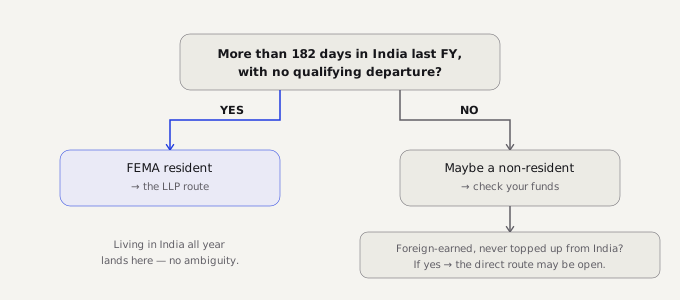
So before anything else, let’s find out which one you are. It changes the entire path.
What is a FEMA resident, loosely?
The rough version, good enough to place yourself: if you’ve been living in India, you’re a FEMA resident.
The test hangs on one number — did you spend more than 182 days in India during the last financial year (the one that ended on 31 March, not the one you’re in now)? If yes, you’re most likely a resident. If you’ve been living abroad, you’re most likely not. That’s usually all you need to know which half of this article is yours.
In short — lived in India this past year? Assume you’re a FEMA resident. Lived abroad? Probably not — but read on, because the details decide it.
What is a FEMA resident, precisely?
Now the careful version, because FEMA is stranger than the rough rule suggests. And a warning up front: it is not the same as income-tax residency. You can be one under FEMA and the other under the tax law, in the same year — they answer different questions.
The base rule counts days: more than 182 in India last financial year makes you a resident. But then FEMA layers intention on top of days — and intention wins. Even if you cleared 182 days last year, you are not a resident if you’ve left India, or are staying away, for a job, for business, or for anything that shows you mean to stay abroad for an uncertain stretch. The mirror applies coming home: arrive in India for work or to settle, and you become a resident from the day you land.
Here’s the part that trips people up. FEMA residency isn’t worked out once a year like a tax return. It changes on a specific date — the day you leave or arrive — based on why you moved. Two people who spent identical days outside India can have opposite FEMA status, if one left for a three-year job and the other for a long holiday. Days set the default; purpose overrides it.
The actual rule — §2(v), FEMA 1999
Section 2(v), Foreign Exchange Management Act, 1999: a “person resident in India” includes a person residing in India for more than one hundred and eighty-two days during the preceding financial year — but excludes (a) a person who has gone out of or stays outside India for employment, for business or vocation, or for any purpose indicating an intention to stay outside India for an uncertain period; and (b) the mirror for those coming to India for such purposes. Section 2(w): a “person resident outside India” is one who is not resident in India. RBI has clarified, for example, that students abroad are treated as resident outside India from departure. Note the deliberate split from the Income-tax Act, which counts only days.
Source: FEMA, 1999 (RBI).
In short — days set the default; the reason you left overrides it; and FEMA status flips on your travel date, not at year-end. It’s also not the same as tax residency.
If you’re a FEMA resident: the LLP route isn’t optional
Here’s the part that isn’t a choice. If you’re a resident and you want to own a US company that has an Indian subsidiary you control, your investment has to travel through the official overseas-investment channel — a designated bank, the filings, a file number, the reporting that follows.
And because a resident individual can’t directly hold a controlled foreign company that has a subsidiary, the practical form that takes is the LLP route: one LLP per founder, investing on your behalf. This isn’t something you can skip by incorporating quietly — the banking system exists precisely to see and record it. The mechanics, costs, and timelines are their own guides; the point here is simpler. As a resident, that route is the route.
In short — if you live in India and your US company will have an Indian subsidiary you control, the LLP route isn’t a preference — it’s the required path.
If you’re a FEMA non-resident: a cleaner path may open
Flip the status and the picture changes. A genuine non-resident — someone who’s actually relocated abroad for work, business, or an indefinite stay — isn’t bound by the resident-individual restrictions the same way. In practice, that can mean incorporating the US company directly, as yourself, with no LLP and no ODI. Cleaner, cheaper, faster.
But — and this is the whole ballgame — that cleaner path depends on the money being genuinely non-resident money. Three things need to be true. Take them as three plain questions:
Are you actually a FEMA non-resident — relocated for a real purpose, not just travelling?
Will you fund the company from a foreign bank account holding money you earned while you were a non-resident?
Has that account stayed clean — never topped up with funds sent from India?
If all three are yes, the money is foreign-sourced end to end, and the direct route is genuinely open. If the account was fed from India, or the money predates your non-residency, the picture blurs — you can no longer cleanly say “these are foreign funds,” and the safe answer swings back to the resident route.
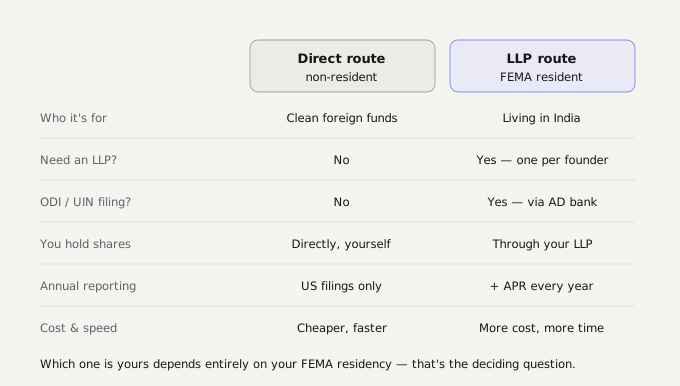
Careful — this is where founders talk themselves into the answer they want.
“I’m basically abroad” isn’t non-residency — leaving for a real purpose is. “It’s mostly foreign money” isn’t a clean account — mixed funds are mixed funds. Getting this wrong, and incorporating directly when you were actually a resident, is exactly the kind of thing that’s painful to unwind later. When it’s close, don’t decide your own status in the mirror — confirm it with someone who does this.
In short — a genuine non-resident with clean foreign funds can often skip the LLP entirely and incorporate directly. ‘Genuine’ and ‘clean’ are doing all the work in that sentence.
What if you’re about to relocate anyway?
A situation that comes up constantly. You’re a resident today, but you’re moving to the US in a few months — for the company, for good. Set up the LLP route now, or wait?
Think about what the LLP route leaves you with. Your US shares sit inside an Indian LLP, on Indian soil, permanently in the structure. When you exit — a sale, a buyback — the money doesn’t reach you directly; it lands in the LLP in India first, then flows to you, with an Indian entity in the middle the whole way. For someone about to become a non-resident and build their life around the US company, that’s a lot of permanent Indian plumbing to install for a status you’re about to shed.
The cleaner move, when it genuinely fits, is sequence: relocate first, then incorporate. FEMA residency changes from the day you leave India for a real purpose — not the day you decide to, and not at year-end, but on actual departure. Leave for the US to build the company, and from that day you’re a non-resident. Incorporate after, from a clean foreign account, and you may never need the LLP route at all — no LLPs, no ODI, no yearly reporting, and no exit routed through an Indian entity.
Two honest guardrails, because this is a real plan, not a trick. It only works if the move is real — you’ve actually left, for a real purpose — not a paper intention while you’re still living in Bengaluru. And the tax picture splits in the moving year: you can be a FEMA non-resident from your departure date while still being an income-tax resident for that whole financial year, if you’d already crossed the day count. FEMA and income tax answer different questions; clearing one doesn’t clear the other. Map both with a CA before you time anything.
In short — if you’re genuinely relocating soon, leaving before you incorporate can skip the LLP route entirely — status flips on your departure date. Just get the tax timing checked, because FEMA and income tax don’t move together.
So what should you do?
One question sits ahead of every other decision: are you a FEMA resident? More than 182 days in India last year with no real departure — you’re a resident, and the LLP route is how you own a US company, full stop. Genuinely relocated abroad, funding from clean foreign money never topped up from India — you may be a non-resident who can incorporate directly. About to move anyway — the order matters, and leaving first can save you installing plumbing you’re about to outgrow. Just don’t settle your own status in the mirror when it’s close. Confirm it.
Not sure which side of the line you’re on — or whether your funds are clean enough for the direct route? That’s the single most valuable thing to get right before you incorporate, and exactly what a free call is for.
Related guides
The LLP route (the resident’s route) · US parent or Indian parent? · Cost & timelines · Delaware C-Corp for Indian founders
Questions people ask
Who is a FEMA resident?
Is FEMA residency the same as income-tax residency?
Can a FEMA non-resident incorporate a US company without the LLP route?
Does deciding to relocate make me a FEMA non-resident?
If I’m relocating soon, should I still do the LLP route now?
Related guides
The IP-before-incorporation question -- coming soon
Returning NRIs / dismantling the LLP later -- coming soon
LRS route for non-controlling investment -- coming soon