US parent or Indian parent? How to pick your C-Corp structure
There are only two ways to build a cross-border startup: America on top, or India on top. Which you pick is mostly decided by who writes your cheques.
The short answer
If you’re raising from US or global VCs, the standard structure is a Delaware C-Corp parent with an Indian subsidiary — investors expect it, and US tax rules reward them for it. If your investors are mostly Indian, an Indian parent with a US subsidiary is often easier for everyone. Who funds you decides what sits on top.
There are only two ways to build an India–US startup: America on top, or India on top. Every acronym your CA throws at you — the LLPs, the ODI filings, the subsidiaries — is just plumbing underneath one of those two choices.
Here’s the thing nobody says plainly: the choice is rarely about tax, and never about patriotism. It’s about who writes your cheques. I’ve watched more than a hundred founders make this call, and almost every time, the structure was decided the day they knew who their investors would be.
So let’s do this the honest way — by investor, not by ideology.
Why do US investors insist on a Delaware C-Corp?
Ask any founder who’s pitched a US fund with an Indian company on the deck. The first question isn’t about the product. It’s “do you have a US entity?” A lot of founders start this whole journey because an investor asked exactly that.
The reason is boringly practical. US venture runs on standard paperwork — the same investment documents, reused thousands of times — and all of it is written for Delaware corporations. Investing in one is fast and familiar. Investing in an Indian company means foreign lawyers and an exit under rules the fund’s own investors never signed up for.
There’s also a tax sweetener with an ugly name: QSBS. It’s a US rule that can make an investor’s eventual gains partly or fully free of federal tax — and it only works for shares in a US C-Corp. So when a US angel pushes you toward Delaware, part of what they’re protecting is their own tax-free exit. That’s alignment, not cynicism.
Each of those deserves more room than a sentence, and QSBS in particular is worth understanding properly — its rules changed in 2025. The full case is its own guide.
In short — US investors want a Delaware C-Corp because their paperwork, their law, and their tax breaks all assume one. Fighting it usually isn’t worth it.
Good — so you know why the parent goes to Delaware. Now the question that trips everyone: why does that US company need an Indian company underneath it?
Why does the Delaware company need an Indian subsidiary?
Because your team is in India. That’s the whole reason the model exists — US money, Indian building.
But a Delaware company can’t employ people in India. No Indian presence means no proper payroll, no provident fund, no clean way to hire. Founders bridge it with contractors, and for a few months it holds. Then three problems show up.
The people problem: good engineers eventually want real jobs — offer letters, benefits, clean stock options — not rolling contracts.
The tax problem: a team in India building for a US company, with nothing in between, can create what’s called a “permanent establishment” — which is a fancy way of saying India decides the US company is really operating here, and taxes a slice of its profits. The fix isn’t to hide the team. It’s to put a proper Indian company in the middle: one that employs everyone and charges the US parent a fair price for the work. That subsidiary is the mitigation, not the risk.
The IP problem: code written by loosely-papered contractors is a mess that surfaces at exactly the wrong moment — your first serious investor’s legal review.
So the operating answer is settled: Delaware parent, Indian subsidiary doing the building. (There’s a bigger cousin of the tax problem called POEM that can make the whole US company Indian for tax — but current rules only worry about it above roughly ₹50 crore of turnover, so it’s a scale problem, not a day-one one.)
In short — a US company can’t employ your Indian team; contractors don’t hold up. An Indian subsidiary that employs everyone and bills the parent is the standard fix.
The wall this walks you into
Follow the logic you just built. You’re an Indian resident. You’d control your Delaware company. It needs an Indian subsidiary. And FEMA doesn’t let a resident individual hold a controlled foreign company that has a subsidiary.
Read that twice, because it’s the whole problem: the exact structure every US investor wants is the one you’re not allowed to hold directly.
The fix is used by almost everyone in this position: hold your Delaware shares through your own small Indian LLP instead of holding them yourself. The restriction is on individuals; an LLP plays by different rules. One LLP per founder. That’s a full guide of its own — what it is, what it costs, the filings that never stop. If you’re on the US-parent path, read it before you form anything.
The shape of it, so you can budget: form and fund one LLP per founder → incorporate the Delaware company (days, via platforms like Stripe Atlas or Clerky) → file the overseas-investment paperwork through your bank → remit, issue shares, finish the US setup → report every year. Roughly one to two months. This — Delaware on top, India building — is the structure accelerators like Y Combinator expect their Indian companies to arrive with.
Careful — the LLP route is market practice, not a written rule.
It’s widely used and broadly considered sound, but it’s legal reasoning backed by practice, not a rule that says so in writing (the honest version of that sentence is in the LLP guide). Set it up with a cross-border CA and a FEMA-aware lawyer — not off a blog post, including this one.
In short — the structure US investors want is one a resident can’t hold directly — so founders hold it through an LLP. One per founder, set up with counsel.
That’s the US-parent path start to finish. But what if some of your money is Indian? That’s the next question — and it has a genuinely clever answer.
Can Indian investors join the US-parent structure? The put-call bridge
Yes — and it matters, because investing directly is sticky for them. Indian funds face limits on how much they can send abroad, and going past those limits means approvals measured in months. Indian angels investing personally take on their own overseas-investment caps and paperwork. So the market built a bridge that keeps their money at home while the economics travel across. It’s called the put-call structure.
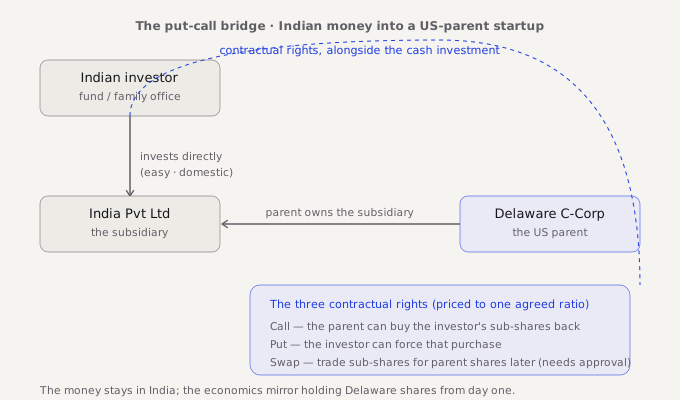
Here’s the shape. The Indian investor puts money where it’s easy — straight into your Indian subsidiary, a normal domestic deal. Alongside it, the contracts add three rights. A call option, letting the US parent buy back those subsidiary shares. A put option, letting the investor force that purchase. And usually a swap right — the ability to trade subsidiary shares for parent shares later, once regulators approve.
The clever part is the pricing. Everything is tied to a pre-agreed ratio, so whatever the investor eventually gets — cash on the options, or parent stock on the swap — mirrors what they’d have earned holding Delaware shares from day one. They hold India; they earn like Delaware.
It works, and serious lawyers build these regularly. But be honest about what it is: a contractual mirror of equity, not equity. If the subsidiary hits trouble, the investor is stuck inside it, behind its creditors, holding options against a parent whose main asset just broke. The swap ratio agreed at the start can be fought over at exit. And India’s pricing rules shape all of it — the options have to be real options, not guaranteed returns dressed up as options.
Who reaches for this: Indian funds and family offices who want into a US-parent startup without burning their overseas quota. Who doesn’t need it: the big cross-border funds, who run both Indian and offshore vehicles and just invest from whichever side fits.
The actual rule — the put-call edges
The bridge exists because of two constraint sets. India side: SEBI permits AIF overseas investment only within an aggregate industry ceiling (when it’s exhausted, prior approval runs to months); resident individuals invest under the LRS subject to the OI Rules. Structure side: FEMA’s pricing framework requires fair-market-value pricing on resident↔non-resident transfers and prohibits assured-return arrangements, so the options must be genuine options; the swap leg, when exercised, is itself an overseas-investment event needing approval.
FEMA counsel: the SEBI limit status is time-sensitive — re-verify before relying. Sources: practitioner guides on cross-border put-call structures · FEMA pricing rules (RBI).
In short — Indian investors can back a US-parent startup by investing in the subsidiary, with call, put, and swap rights priced to mirror parent shares. It’s a contractual mirror of equity, not equity — powerful, with real edges.
When does the Indian parent structure win instead?
Flip the investor base and the logic flips with it. If your money is mostly Indian — angels, family offices, domestic funds — an Indian company as the parent, with a US subsidiary underneath, is often the path of least resistance. Your investors invest at home, in rupees, in instruments they know, with no overseas approvals. The US subsidiary still gives you everything American you actually need — billing, contracting, a bank account — because those come from any US entity, parent or not.
The honest costs of India-on-top: US and global VCs will push back — everything in the first section, in reverse. QSBS won’t be available to your US investors. And if you later need a Delaware parent after all, the restructuring has a name, the flip, and a reputation: expensive, slow, tax-heavy. Choose India-parent because your funding path is genuinely Indian — not because it’s this month’s easier meeting.
One wrinkle worth thirty seconds: Indian angels often can’t use the instrument US angels love — the SAFE. An Indian company legally can’t issue one; India’s version, the iSAFE, is preference shares in a SAFE costume. The full story is its own guide.
In short — Indian parent wins when your funding is genuinely Indian — investors stay home, and the US subsidiary still does everything American you need. Just know a later flip is costly.
So how do you actually choose?
One question does most of the work: where will your next two rounds come from?
US or global funds → Delaware parent, Indian subsidiary, and the LLP route. Read that guide next.
Indian money → consider the Indian parent seriously, and understand what a later flip costs before you commit.
A mix → the put-call bridge above is exactly how mixed cap tables get built on a US parent.
Genuinely unsure → that’s the most common position there is, and it’s exactly what a free call is for.
Choosing right the first time is far cheaper than flipping later. If your structure isn’t built for your investors, it’s built for a rewrite.
Staring at both structures and can’t place yourself? Book a free call — that’s what it’s for.
Related guides
The LLP route · Why investors prefer Delaware C-Corps · SAFEs and iSAFEs · The Delaware flip · Cost & timelines · Delaware C-Corp for Indian founders
Questions people ask
Which structure do US VCs prefer for Indian startups?
Why does the Delaware parent need an Indian subsidiary?
Can an Indian founder directly own a Delaware parent with an Indian subsidiary?
What is the put-call structure for Indian investors?
When is an Indian parent the better structure?
Related guides
The IP-before-incorporation question -- coming soon
Returning NRIs / dismantling the LLP later -- coming soon
LRS route for non-controlling investment -- coming soon