SAFEs and iSAFEs, explained for Indian founders
US startups raise on SAFEs. Indian startups can’t — not exactly. What’s legal on each side of the border, and what the iSAFE really is.
The short answer
An Indian company cannot issue a US-style SAFE — Indian law only recognises real instruments like equity shares, preference shares, and debentures, and a SAFE is none of them. India’s version, the iSAFE, is legally preference shares dressed up to mimic a SAFE’s deferred pricing. A Delaware C-Corp, of course, can issue the real thing.
Every Indian founder who reads Silicon Valley advice eventually asks the same question: can I just raise on a SAFE? The answer is one of those rare cases where the law is clearer than the folklore — and knowing it tells you something about which side of the border your company belongs on.
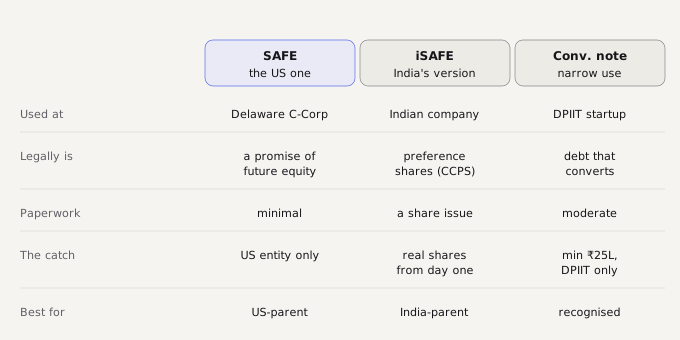
What is a SAFE, and why does everyone love it?
A SAFE — Simple Agreement for Future Equity — is a promise, not a share. The investor wires money today; the company promises them equity later, priced at the next real round (usually with a discount or a cap). No valuation fight today, no interest, no maturity date. Five pages, done.
Y Combinator built it to make seed investing frictionless, and in the US it worked: SAFEs stack quietly on a Delaware cap table until a priced round converts them all at once. Notice the two words doing the work — promise and later. A SAFE is deliberately neither debt nor equity. That’s its charm in the US, and its problem in India.
In short — a SAFE is money now for equity later, at the next round’s price. Simple, fast, and built entirely around US law.
Why can’t an Indian company issue a SAFE?
Because Indian law doesn’t have a box for it. An Indian company can issue the instruments the Companies Act recognises — equity shares, preference shares, debentures — and when foreign money is involved, only a short list of approved instruments is allowed. A SAFE is future equity: it isn’t shares yet, it isn’t debt, and “we’ll figure it out later” isn’t on the list.
Issue one anyway and you haven’t cleverly imported Silicon Valley — you’ve created a contract of uncertain standing that can trip company-law and FEMA compliance at once.
The actual rule — what an Indian company may issue
The Companies Act, 2013 defines the securities an Indian company may issue and the process (private placement, valuation, allotment). For foreign investors, the FEMA Non-Debt Instrument framework recognises only specified “capital instruments” — equity shares, compulsorily convertible preference shares (CCPS), compulsorily convertible debentures, and share warrants — each with pricing and reporting rules. An instrument deferring both the shares and the price fits none, which is why practitioners treat US-form SAFEs as unavailable to Indian companies.
Expertise: confirm framing and add precise citations before relying. Sources: Companies Act, 2013 · NDI Rules (RBI).
In short — India only recognises real instruments. A SAFE is a promise of future equity — so an Indian company legally can’t issue one.
So what is an iSAFE, really?
India’s workaround, pioneered by 100X.VC. The honest description: an iSAFE is Compulsorily Convertible Preference Shares — real shares that must convert to equity later — wearing a SAFE costume. It borrows the SAFE’s spirit (no valuation fight today, conversion at the next priced round) but it is legally real shares from day one.
That difference isn’t pedantry; it changes the experience. A US SAFE closes in days on a template. An iSAFE is a proper share issuance — a valuation, a private placement, an allotment, a token mandatory dividend (preference shares must carry one, usually a nominal 0.0001%), board and shareholder mechanics. Price-deferred, yes. Unpriced and weightless, no — the investor is on your cap table now, not later.
In short — an iSAFE is real preference shares mimicking a SAFE. Same spirit, but more paperwork, and the investor holds actual shares from day one.
What about convertible notes?
Yes, with a velvet rope. India carved out a convertible-note route, but only for startups recognised by the government’s DPIIT programme, with a minimum ticket of ₹25 lakh per investor, converting or repaying within ten years. Genuinely useful inside that fence — and irrelevant outside it. If your angel wants to write a ₹5 lakh cheque on a note, the fence says no.
In short — convertible notes exist in India, but only for DPIIT-recognised startups, minimum ₹25 lakh a ticket. Narrow, not general.
The symmetry that ties it together
Here’s the part that makes this a structure question. An Indian angel can sign a genuine, YC-form SAFE — at your Delaware parent. It was never the Indian person who couldn’t sign; it’s the Indian company that can’t issue.
But the moment they do, they’re investing overseas — with the LRS limit, the ODI paperwork, a UIN. That friction is exactly why most Indian money prefers investing at home, and it’s why the put-call bridge exists inside the structure chooser. “Who funds you decides what sits on top” keeps being the answer: US investors want SAFEs on a Delaware cap table; Indian investors want familiar instruments in an Indian company.
Careful — instrument choice is where diligence problems hide.
A mispriced iSAFE, a SAFE issued by an Indian entity “because the template was there,” a note to a non-DPIIT company — this is where founders quietly create diligence problems. This is general information; the specific instrument, pricing, and process for your round needs a lawyer and a CA who do this weekly, not a template and hope.
The short version
SAFEs live where C-Corps live. Delaware parent? Raise on SAFEs like everyone else — your Indian angels can even join, overseas-investment paperwork permitting. Indian parent? Your menu is iSAFEs, priced equity, or (for DPIIT startups) convertible notes. Nobody’s being cheated; the two legal systems just refuse to recognise each other’s shortcuts.
Deciding instruments before you’ve decided structure is doing it backwards. Not sure which side of the border your parent belongs on? Book a free call.
Related guides
US parent or Indian parent? (incl. put-call) · Why investors prefer Delaware C-Corps · The LLP route · Delaware C-Corp for Indian founders
Questions people ask
Can an Indian company legally issue a SAFE?
What is an iSAFE and how is it different from a SAFE?
Can Indian angels invest through SAFEs at all?
Who can issue convertible notes in India?
Related guides
The IP-before-incorporation question -- coming soon
Returning NRIs / dismantling the LLP later -- coming soon
LRS route for non-controlling investment -- coming soon