Why investors prefer Delaware C-Corps (and what it means for you)
When a US investor asks for a Delaware C-Corp, they're not being fussy. They're protecting three things at once — and one of them is their own tax-free exit.
The short answer
US investors prefer Delaware C-Corps for three reasons: the standard venture paperwork is all written for them, Delaware's corporate law is the most predictable anywhere, and a US tax rule called QSBS can make an investor's exit gains largely tax-free — but only on C-Corp stock. Investing in an Indian company gives them none of the three.
A US investor looks at your deck, likes it, and asks one question before any other: “Are you a Delaware C-Corp?” It can feel like a bureaucratic hoop. It isn’t. They’re protecting three specific things — and one of them is their own tax-free exit.
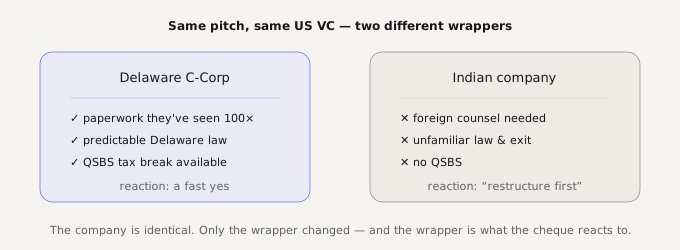
Let’s take the three reasons one at a time, because understanding them tells you something useful: not just what investors want, but how much room you have to negotiate (almost none) and why.
Reason one: the paperwork already exists
US venture capital runs on standard documents. The same investment agreements, the same terms, reused across thousands of deals — and every one of them is written for a Delaware corporation. An investor putting money into your Delaware C-Corp is signing paperwork their lawyers have seen a hundred times. Fast, cheap, familiar.
Now ask them to invest in your Indian company instead. Suddenly they need Indian lawyers, Indian law, and an exit governed by a system their own investors never agreed to. The deal that took a week now takes months. Most funds simply say no — not because your company is weaker, but because the wrapper is unfamiliar.
In short — venture paperwork is built for Delaware companies. Investing in one is routine; investing in an Indian company is a custom legal project most funds won’t take on.
Reason two: Delaware law is predictable
This one sounds dry and matters enormously. Delaware has spent over a century building the most tested body of corporate law in the world, with a dedicated court that does nothing else. When an investor wonders how a dispute would play out — a down round, a founder removal, an acquisition fight — Delaware gives them a shelf of prior cases and very few surprises.
There’s a second, quieter piece here too. The machinery investors use to structure their risk — preferred stock (shares that pay out before yours if things go sideways), option pools, the standard protective terms — all of it exists natively in a C-Corp and is understood identically by everyone at the table. Investors get tools they trust, interpreted the way they expect.
In short — a century of tested law and a specialist court mean fewer surprises — and the preferred-stock tools investors rely on are native to a C-Corp.
Those two are about safety and convenience. The third is about money — and it’s the one that quietly aligns the investor with you.
Reason three: the tax break called QSBS
Here’s the one founders rarely know about, and it explains a lot. There’s a US tax provision — Qualified Small Business Stock, or QSBS — that can let an investor pay little or no federal tax on their gains when they sell, provided they held stock in a qualifying US C-Corp for long enough.
Sit with what that means. On a good outcome, the difference between a C-Corp and almost any other structure can be an enormous tax saving for the investor — and it exists only for C-Corp shares. So when a US angel nudges you toward Delaware, part of what they’re protecting is their own tax-free exit. That’s not cynicism; it’s alignment. The structure that saves them tax is the same one that makes them eager to fund you.
QSBS matters to you directly, too — as a founder, your own shares can qualify. And the rules were made meaningfully more generous in 2025, with faster access to partial exemptions and higher caps. The specifics belong in the capitalisation guide, but the headline is: this is a reason to be a C-Corp, not just a reason investors like them.
The actual rule — QSBS after the 2025 changes
Section 1202 of the US Internal Revenue Code (Qualified Small Business Stock). For stock acquired after 4 July 2025: a tiered exclusion of capital gains — 50% at 3 years held, 75% at 4 years, 100% at 5 years; a per-issuer cap raised to USD 15 million (indexed); and a gross-assets ceiling on the issuer raised to USD 75 million at issuance. Stock acquired earlier retains the prior rules (generally 5-year hold for 100%, USD 10m / 10× cap). The issuer must be a domestic C-corporation meeting the active-business and asset tests; several sectors are excluded. Gains beyond the exclusion are taxed at the 28% QSBS rate.
US tax adviser: confirm current thresholds and eligibility for the specific facts before relying. Source: IRC §1202.
In short — QSBS can make a qualifying C-Corp investor’s gains largely federal-tax-free — and it works for your founder shares too. It only exists for C-Corps, and it got more generous in 2025.
What this means for you
Put the three together and the takeaway is simple: if you’re raising from US or global investors, being a Delaware C-Corp is effectively non-negotiable, and that’s fine — the same features that make investors comfortable make your own life easier and your own eventual exit more tax-efficient.
The interesting question was never whether to be a Delaware C-Corp. It’s how an Indian founder is actually allowed to own one — because a resident can’t simply hold a US parent with an Indian subsidiary directly. That’s the whole subject of the LLP route, and it’s where most founders’ real work begins.
One honest counterweight, so this doesn’t read as a sales pitch for Delaware: if your investors are going to be Indian rather than American, all three reasons weaken, and an Indian parent may serve you better. That trade-off is the structure chooser.
In short — raising US money means a Delaware C-Corp — and its perks are yours too. The real question is how you’re allowed to own one from India, which is the LLP route.
Trying to work out whether a Delaware C-Corp is right for your funding path — or how to own one cleanly from India? Book a free call.
Continue the C-Corp track
← Previous: FEMA residency
Next: US parent or Indian parent? →
Questions people ask
Why do US investors want a Delaware C-Corp?
What is QSBS and why does it matter to Indian founders?
Can I raise from US VCs with an Indian company?
Is a Delaware C-Corp always the right choice?
Related guides
The IP-before-incorporation question -- coming soon
Returning NRIs / dismantling the LLP later -- coming soon
LRS route for non-controlling investment -- coming soon