The Delaware flip: moving your Indian startup under a US parent
The flip is the most expensive way to arrive at a structure you could have chosen on day one. Sometimes it’s still the right call. Here’s the honest map.
The short answer
A Delaware flip restructures an Indian startup under a new US parent — usually by shareholders swapping their Indian shares for the Delaware company’s stock, turning the Indian company into a subsidiary. It’s legally possible, tax-expensive (the swap is a taxable transfer in India), and slow enough that founders who can choose the structure upfront should.
Every few months a founder arrives with the same story: built in India, on an Indian company, and now a US accelerator or lead investor wants a Delaware parent before the cheque clears. The restructuring they’re asking for has a name — the flip — and a reputation it has fully earned.
This guide is the honest map: what a flip is, why it costs what it costs, and how to tell whether you’re a flip case. What it is not is a how-to — a flip is a multi-adviser project (FEMA counsel, Indian tax, US tax), not a checklist.
What actually happens in a flip?
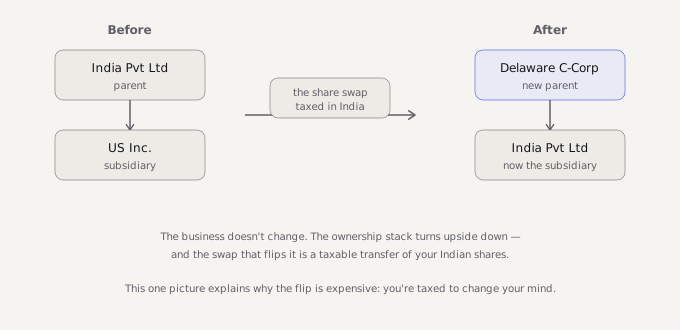
Mechanically, an inversion — the ownership stack gets turned upside down. A new Delaware C-Corp is created. The Indian company’s shareholders — founders, angels, everyone — hand over their Indian shares and receive shares of the Delaware company instead, in agreed ratios. When the music stops, the cap table has moved to Delaware, and the Indian company is now the US parent’s subsidiary. The business hasn’t changed; the ownership has flipped.
Every group on the cap table has to come along, which is why flips are project-managed like small M&A deals: each shareholder class, each instrument, each stock-option grant needs a treatment. The more history your cap table has, the more the flip costs — in fees and in time.
In short — a flip creates a US parent and moves everyone’s shares up into it, making the old Indian company a subsidiary. It’s an ownership inversion, run like a small M&A deal.
Why is it so expensive?
Three stacked reasons.
Tax, first and largest. Swapping your Indian shares is a transfer — and India taxes transfers. There’s no general relief that lets Indian shareholders swap into a foreign parent tax-free; gains crystallise at the swap, on valuation-derived numbers, potentially years before anyone sees cash. For founders with meaningful paper value, this is the line item that kills or delays flips.
Regulation, second. A flip is FEMA on both legs at once: residents acquiring the foreign parent’s shares (an overseas-investment event), while the foreign parent simultaneously acquires the Indian company (a foreign-investment event) — all inside the round-tripping framework. Each leg has valuation, pricing, and filing rules, and they must reconcile.
Coordination, third. US tax has its own view of the inversion; investor consents, option rollovers, and contract assignments all move; and the company runs on lawyers for a quarter or two. And note where founders usually land: resident founders taking the US parent’s shares typically end up holding them through the LLP route — the same place they’d have started.
The actual rule — what a flip touches
A flip touches: (1) Indian capital-gains tax on the share swap — transfer of a capital asset, no general rollover relief for a swap into a foreign holdco, gains computed on valuation; (2) FEMA both legs — residents’ acquisition of foreign-parent shares under the OI Rules (swap-based acquisitions have their own pathway), and the foreign parent’s acquisition of the Indian company under the FDI/NDI framework with pricing and reporting; (3) the round-tripping / two-layer framework; (4) US tax treatment of the inversion.
FEMA + tax counsel: exact characterisation, valuation mechanics, and the current swap pathway require review for any specific case. Sources: OI Rules (RBI) · NDI Rules (RBI).
In short — the swap is taxed in India, it’s FEMA on both legs at once, and US tax plus coordination pile on. Cap-table history multiplies all of it.
So when is flipping actually worth it?
When the money that requires it is real and committed — a term sheet conditioned on a Delaware parent, an accelerator admission, a US acquirer — and the tax bill has been computed, not guessed. It’s usually not worth it for speculative access (“US VCs might like us more”), because you’re paying certain costs for uncertain benefits.
And the honest counterweight belongs in the same breath: traffic runs both ways. The last few years have seen prominent reverse flips — companies moving their parents back to India for a domestic listing. The structure is a tool, not a destiny.
Which is the real moral, and why this guide links back rather than forward: if you’re early enough to be reading this before you’ve raised, you’re early enough to choose the right parent now. That decision — by investor base, honestly made — is the structure chooser. The flip is what it costs to change your answer later.
Careful — this is a map, not a manual.
A flip touches FEMA on both legs, Indian capital-gains tax at the swap, US tax, and every document your company has signed. Nothing here is advice, figures are deliberately absent, and the only correct first step is engaging FEMA-aware counsel and tax advisers on both sides — before the term-sheet clock starts running.
Holding a term sheet that wants a Delaware parent, or trying to avoid ever needing one? Both are worth a free call.
Related guides
US parent or Indian parent? · The LLP route · Why investors prefer Delaware C-Corps · Delaware C-Corp for Indian founders
Questions people ask
What is a Delaware flip?
Is flipping an Indian company to the US legal?
Why is the flip considered expensive?
Should I flip, or start with a US parent?
Related guides
The IP-before-incorporation question -- coming soon
Returning NRIs / dismantling the LLP later -- coming soon
LRS route for non-controlling investment -- coming soon