Stripe Atlas for Indian founders: it creates the company, not the structure
Atlas incorporates your US company in minutes. That's the easy half. The harder half is what it leaves you — a C-Corp that isn't yet fundable, and LLC guidance that's easy to misread into skipping India's rules.
The short answer
Yes — if you follow Stripe’s India guide, Atlas is now a proper, rule-following way to open your US company. What that gets you depends on your plan. If you’re raising investor money, Atlas sets the company up correctly but not ready to raise into — you’ll rebuild it later, with a lawyer. If you’re not raising, Atlas makes it sound like there’s no India paperwork as long as you keep the money small — but owning a company abroad still has to be registered with India (a process called ODI), whatever the amount.
For years, the advice on Stripe Atlas in India was one word: don’t. Founders who’d used it were told — loudly, on public forums — that they’d broken an Indian rule they couldn’t undo, and that the only fix was to shut the company down and start over. Some did exactly that, closing perfectly good US companies out of fear.
That advice is now out of date. In 2025, Stripe published a guide for Indian founders that lays out a proper, rule-following way to use Atlas from India. It works. But “it works” hides a more useful question — and the answer depends entirely on what you’re building.
First, what Stripe Atlas actually does
If you’ve never incorporated a company before, here’s the plain version. “Incorporating” just means officially creating a company — registering it with a government so that it legally exists as its own thing, separate from you. Stripe Atlas is a service that does this for you in the United States, in a few clicks, for about $500. It registers the company in Delaware (the US state most startups use), gets it a tax ID, and hands you the starter paperwork.
Atlas can create two kinds of US company, and this difference matters more than anything else on this page:
An LLC — the simpler kind. Good if you’re selling to US customers, sending invoices, or you just want a US bank account, and you’re not planning to raise money from investors.
A C-Corporation (everyone shortens it to “C-Corp”) — the kind investors expect. If you’re going to raise venture capital, this is the one you need.
For founders in most of the world, you pick one and you’re done. The reason there’s a whole separate guide for Indian founders — and this article — is that India has extra rules about its residents owning things abroad. Those rules are the entire story here.
Those rules come from a law called FEMA, the Foreign Exchange Management Act. In plain terms, FEMA is India’s rulebook for money and assets crossing its borders — sending money out, and owning things outside India. Opening a US company means owning something abroad, so FEMA has a say in it. (FEMA also has its own definition of who counts as a “resident,” which decides whether these rules even apply to you — that’s a separate question worth checking.) “Just use Atlas” is what used to skip straight past all of this.
Hold onto one idea, because the whole article turns on it: creating a company and structuring a company are two different jobs. Atlas is genuinely good at the first — it creates the company. The second, the cross-border ownership that goes around it, is the part that’s left to you, and the part people miss.
First — which founder are you?
The guide, and this article, really serve two different people. Work out which one is you, because the rest changes depending on the answer.
Founder A · Not raising · US LLC. Building something with customers — an agency, a small software product, freelance work — and wants a US company to invoice through and hold a US bank account. Not raising from investors. Atlas points her to an LLC.
Founder B · Raising · C-Corp. Building a startup he plans to raise venture capital for. Needs the company investors will fund — a C-Corp — set up the specific way Atlas uses for Indian founders.
Same service, same word “compliant,” two different roads — and a different catch waiting on each. We’ll take them one at a time, starting with the founder who’s raising.
In short — selling to customers and not raising? You’re Founder A — a US LLC. Raising venture capital? You’re Founder B — a C-Corp. Atlas serves both, but the catch is different for each.
The raising founder: how Stripe’s India route works, and the catch inside it
Before the catch, it helps to understand what Stripe actually built — because the catch is a side effect of it.
Here’s the problem Stripe had to solve. India generally won’t let one of its residents personally own a foreign company that then owns an Indian company — and even setting that aside, an Indian resident can’t just buy shares in a foreign company the way you’d buy a domain name. Money leaving India to buy something abroad has to travel through an official channel, with a bank and some paperwork. Do it casually, and you’ve broken a FEMA rule without realising it. That’s exactly what used to happen with Atlas.
Stripe’s fix is a change in who owns the company. Instead of you personally owning the US C-Corp, you first set up a small Indian entity called an LLP — a Limited Liability Partnership. Think of it as your own little holding company in India: quick and cheap to register, and it’s the thing that will legally own your US company. The US C-Corp is then owned by your LLP, not by you directly. (Here’s the full walkthrough of setting up the LLP — this piece just needs the shape of it.)
Why does that help? Because now the investment abroad is being made by your Indian LLP, through the proper channel — and that channel has a name: ODI, short for Overseas Direct Investment. ODI is simply the official process for an Indian person or company investing in a business abroad. India wants a record of it, so there are a few steps:
The money leaves India through your bank — specifically an AD Bank, an “Authorised Dealer” bank, meaning one that’s licensed to handle foreign-exchange transactions. Most major Indian banks are AD banks.
Your foreign investment gets a tracking number called a UIN (Unique Identification Number) — like a registration number for this specific investment abroad.
And FEMA is strict about the order: the UIN has to exist, and the money has to move the proper way, before you actually take ownership of the shares.
That last point is the whole trick, and it’s worth slowing down on.
Atlas does one clever thing to make it work: in this Indian setup, it does not automatically give you the shares of your new company. In a normal Atlas company, you’d get your shares the moment it’s created. Here, that step is deliberately left out. The document that actually transfers the shares to your LLP — the stock purchase agreement — sits outside Atlas entirely, and it should only be signed after the ODI money has genuinely moved from your LLP’s Indian bank account into the US company’s bank account. Form the company, get the UIN, send the money the proper way, and only then sign the shares over. In that order, you’ve stayed inside FEMA’s rules.
The actual rule — a UIN before the money moves
Under the Foreign Exchange Management (Overseas Investment) Regulations, 2022 (Regulation 9), a resident must obtain a UIN through the designated AD Bank before the outward remittance or the acquisition of the foreign entity’s shares — whichever is earlier — and the investment is routed and reported through that AD Bank on Form FC. That is the rule. Leaving the share purchase to a separate agreement signed after the money lands, as Atlas does, is just the practical way founders keep to it.
Source: RBI OI Directions, 2022 (A.P. (DIR Series) Circular No. 12).
Now the catch. To see it, you need one fact about how Stripe pulled this off: they relaunched in India without building a new product. They reused a feature Atlas already had — a mode for creating a company as a “subsidiary” of a parent company. It’s a clever, fast solution. But it has a side effect. Companies made in this subsidiary mode come with just 1,000 shares, priced at ten cents each. Own half the company and you hold 500 shares.
For a genuine subsidiary, 1,000 shares is completely fine — because a real subsidiary never raises money or hands out equity. Its parent company does all of that; the subsidiary just operates underneath. It has no need for a big pile of shares to divide up.
But look at what your company actually is. On paper, it’s a “subsidiary” of your LLP. In practice, it’s the company that will raise from investors, give stock options to employees, and take investment. That’s not how a subsidiary behaves — that’s what a parent company does. You’ve been handed a subsidiary-sized share structure for a company that’s going to live like a fundraising parent. And a fundraising company with only 1,000 shares doesn’t hold up.
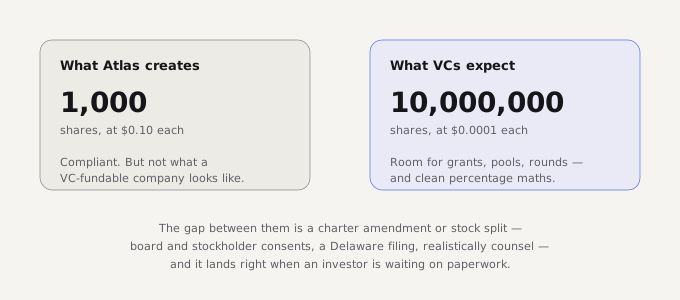
What the India route creates, versus what a company that will raise actually needs.
The standard for a company that will raise is 10,000,000 shares. The exact number is a convention, but the size matters for a practical reason: when you give an employee 0.5% of the company, or set aside a pool of shares for future hires, or take investment that converts into shares later, you need enough shares to divide cleanly into small slices. With only 1,000 shares, you can’t hand someone a clean 0.25% — the maths turns ugly fast. Investors, their lawyers, and the software everyone uses to track ownership all assume the 10-million shape. (More on the 10-million-share convention and why par value is tiny.)
So a founder who finishes the Atlas route — LLP set up, money routed, UIN in hand, fully compliant — is still holding a company that has to be rebuilt before it can raise. You can do everything right and still not be ready.
There’s a second thing left for you, and it’s paperwork. In this setup, the documents that establish your ownership — the stock purchase agreement, the vesting terms (the schedule over which your shares become truly yours), the board approval, and a US tax filing called an 83(b) election (a quick form that can save you a lot in US tax later, but has a strict 30-day deadline) — arrive as fill-in templates you complete yourself. Stripe says, fairly, that you can do these without a lawyer, while encouraging you to consult one. If you’re careful with paperwork, that’s fine. If you’re not, it’s the kind of thing that turns into a problem later, when an investor’s lawyer reviews everything before a deal.
It helps to see exactly what’s in the box, and what isn’t. In the box: the company itself — the certificate that creates it, the bylaws (its internal rulebook), the setup approvals, an indemnification agreement, and the US tax-ID forms. That’s a real company. Not in the box: the two documents an investor looks at hardest — proof of who owns the shares, and proof the company owns the work its founders create.
That second one has a name: a CIIA (Confidential Information and Invention Assignment Agreement). It’s the document that says everything the founders build belongs to the company, not to them personally — investors insist on it, because they’re funding a company that must actually own its technology. Here’s the surprising part: a normal Atlas C-Corp includes a CIIA automatically. The Indian route drops it. The reason is mechanical — a normal Atlas company gives founders their shares in exchange for their intellectual property, and that same step carries the IP across to the company. The Indian route can’t work that way, because your LLP has to buy the shares with real money through the bank. So the IP-assignment falls out of the process, and putting it in place is now on you. That one is worth a lawyer, not a template. Atlas created the company. Structuring it — who owns the shares, who owns the IP — is the other job, and it’s still yours.
In short — Atlas’s India route creates a compliant company that isn’t ready to raise: 1,000 shares, and the ownership and IP paperwork left to you — including a CIIA a normal Atlas C-Corp would have included. Before you can raise, it needs rebuilding to the standard 10 million shares. Two of these — the share purchase and the CIIA — are worth doing with a lawyer.
Step back and notice the irony. You did the whole dance — LLP first, money through the bank, UIN, ODI reported — for one reason: so you could raise. And the company that comes out the other end is compliant, but not yet something an investor can put money into. The 1,000-share company has to be rebuilt first — which is the one job you set it up to do.
To get there, a lawyer finishes three things: the share purchase agreement, the CIIA, and the share increase (a “stock split,” or changing the company’s charter to allow more shares). Budget roughly $1,500–$5,000 (about ₹1.3–4.3 lakh) in legal and filing fees for that — the share increase alone usually runs $1,000–$2,500 in legal fees plus a few hundred in government filing, and the ownership and IP documents add to it. It varies by lawyer, so get a quote. None of this is a reason to avoid Atlas. It’s a reason to plan the rebuild before an investor is at the table, not during. (If you’re still deciding how to structure all this, start with the chooser.)
The not-raising founder: the one line that’s easy to misread
Now Founder A — and here a single sentence causes real damage.
First, the limit everyone talks about. India lets each resident send up to $250,000 out of the country per year for personal purposes — investing, gifts, travel, education, and so on. This yearly allowance has a name: the LRS, or Liberalised Remittance Scheme. It’s simply a cap on how much money you personally can move abroad in a year. Hold on to that idea — it’s about to get mixed up with a completely different one.
Here’s what Stripe’s guide says to the founder who isn’t raising:
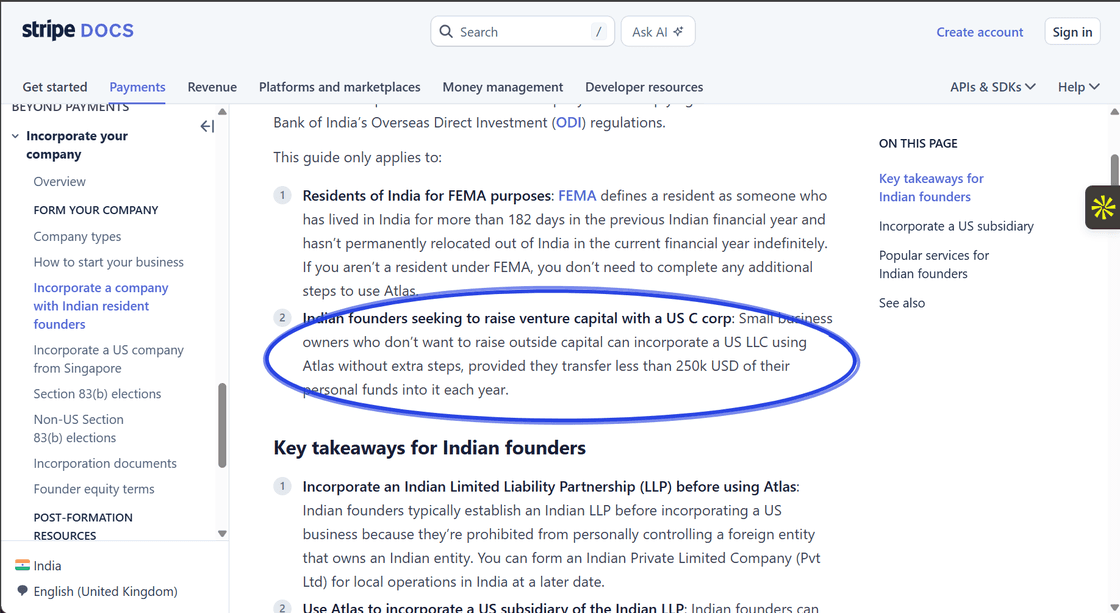
The line itself, on Stripe’s Indian Founder Guide — easy for an Indian founder to read as “no paperwork,” which isn’t quite what it means.
Read quickly, that sounds like: as long as I keep the money under $250,000 a year, there’s no India paperwork for owning a US LLC. That reading is wrong, and it’s one of the most expensive mistakes an Indian founder can make here.
The mistake is mixing up two completely separate rules:
One rule is about sending money out — that’s the LRS, the $250,000 cap. It answers the question “how much can I move abroad this year?”
A different rule is about owning a company abroad — that’s the ODI process from Founder B’s section (the UIN, the bank, the reporting). It answers a different question: “am I allowed to own this, and did I register it?”
Staying under $250,000 keeps you inside the first rule. It does nothing about the second. Owning a US LLC is still an investment abroad in India’s eyes, no matter how little money you put in — so it still has to be registered and reported. You could send a single dollar and still owe the paperwork.
Short answer — under $250k is not “paperwork-free”
No — staying under the $250,000 limit does not make owning a US LLC “paperwork-free.” That limit is only about how much money you can send abroad each year. Owning the company is a separate matter: in India’s eyes it’s an investment abroad (ODI), which has to be registered (a UIN), routed through your bank, and reported once a year — whatever the amount you actually sent.
The actual rule — LRS caps sending, ODI governs owning
Under India’s Overseas Investment (OI) Rules, 2022, a resident individual who acquires ownership or control of an unlisted foreign company is making Overseas Direct Investment (ODI) — distinct from the LRS remittance limit, which only caps the amount sent. A resident individual may make ODI within the LRS limit, but only into a genuine operating business (not financial services). It requires a UIN and a filing (Form FC) through the AD Bank before the money moves, and an Annual Performance Report (APR) each year — certified by a chartered accountant where no audit applies, which includes individuals.
Sources: RBI OI Directions, 2022 · RBI Form FC.
So what does the mistake cost? This is why founders end up doing “backdated” cleanups. If you skip the registration and the yearly reports, you haven’t dodged them — you’ve just made them late. India charges a Late Submission Fee: ₹7,500 plus a small percentage of the amount for each year the registration is late, and a flat ₹7,500 for every yearly report you missed. Worse than the money: an unfixed reporting gap can block your next move abroad until it’s sorted, and it tends to surface at the worst possible time.
The $250,000 limit governs what you send. It says nothing about what you now own.
In short — “Under $250k means no paperwork” is the dangerous misread. The limit only caps how much you send. Owning the LLC is an investment abroad regardless — it needs a UIN, must go through your bank, and must be reported yearly. Skip it and you’re not exempt, just late: ₹7,500-plus per missed filing, and a block on your next move.
So what should you do?
Both roads, laid on one map.
If you’re Founder A (LLC, not raising): Atlas at $500 is a fine, cheap way in — just don’t mistake the sending limit for permission to skip the ownership paperwork. From day one, plan the ODI: get the UIN, route the money through your AD Bank before you fund the company, and file the yearly report. A FEMA-aware CA (chartered accountant) sets this up once. It’s cheap when it’s done on time, and painful only when it’s ignored.
If you’re Founder B (C-Corp, raising): Atlas at $500 is the cheapest compliant start — just plan the rebuild to 10 million shares before investors show up, not during. Or, if you’d rather do it once, services built on a tool called Clerky (around $999) create the investor-standard company from the start — 10 million shares, all the documents included — and skip the rebuild entirely.
Either way, here’s the frame worth remembering — the same one we started with. Creating a company and structuring it are two different jobs. Atlas, or any tool like it, does the first: it creates the company, the American half. Structuring it — for India and for investors, the LLP, the ODI, the UIN, the money routed correctly, the report every year — is the second, and it’s yours, with your CA and your bank. (The full picture of the US-plus-India structure is here.)
Careful — before you rely on this
Atlas’s steps, prices, and guide are current as of July 2026 and are Stripe’s to change — check the live guide before you rely on any single step. And if you already set things up the old way — as yourself, or by funding an LLC thinking the $250k limit had you covered — don’t panic, and don’t make it worse. A cleanup is a case-by-case conversation with a FEMA-aware CA or lawyer. The one genuinely bad move is to keep sending more money on top of a shaky base.
The short version
Atlas’s India relaunch is real, and done properly it follows the rules — for both founders. If you’re raising, it hands you a company that isn’t ready to raise (1,000 shares, and your ownership and IP paperwork to finish) that has to be rebuilt before an investor can fund it. If you’re not, it hands you a US LLC — and owning that LLC has to be registered and reported no matter how little you send, because the $250,000 limit is only about sending, not owning. The tool does the American half. The Indian half is still yours.
Where to go from here
This guide is the doorway, not the whole house. If you’re setting up a US company from India, here’s the order I’d read the rest of indieincorp in — each one is the next question this article opens up.
Start with the big picture — the whole US-plus-India structure in one place, the map before the details.
Check whether any of this is even yours — FEMA only binds “residents.” A few minutes here tells you whether these rules apply to you at all.
Set up the India side, step by step — the LLP, the ODI, the UIN, the half Atlas doesn’t do, walked through slowly.
Decide which structure fits — US parent or India parent? The choice that shapes everything downstream.
Make the company investor-ready — the 10-million-share setup and par value, the cap table investors expect.
Know the cost and timeline — real numbers and realistic timelines, so nothing surprises you.
And when a raise is actually on the horizon: why investors prefer Delaware C-Corps, how SAFEs and iSAFEs work, and the Delaware flip.
Not sure about something? That’s exactly what the call is for. Bring the thing you’re unsure about — your structure, your paperwork, or a quote someone’s given you — and we’ll work through it in fifteen minutes. Book a free call.
Related guides
The LLP route · Cost & timelines · Capitalising your C-Corp · US parent or India parent? · FEMA residency · The pillar guide
Questions people ask
Is Stripe Atlas legal for Indian resident founders now?
Do I need to register my US LLC in India if I stay under the $250,000 limit?
What's the difference between the LRS limit and ODI?
What happens if I never registered my US company as ODI?
Why was Stripe Atlas once considered a FEMA problem?
What's wrong with the 1,000 shares Atlas creates?
Should I use Stripe Atlas or a Clerky-based service?
Does funding my US LLC trigger extra tax?
Is Stripe Atlas safe for Indian founders?
Is Stripe Atlas legit?
Is Stripe Atlas worth it for Indian founders?
Is Stripe Atlas available in India?
Does Stripe Atlas set up a US bank account?
Related guides
The IP-before-incorporation question -- coming soon
Returning NRIs / dismantling the LLP later -- coming soon
LRS route for non-controlling investment -- coming soon